The CARE Framework for Clinical Supervision™
A developmental lens for more intentional clinical supervision
Supervision has to do more than solve today's problem.
When a supervisee brings a difficult case, an ethical question, uncertainty about documentation, a challenging interaction, or simply asks, “What should I do?”, a supervisor can help them find an answer.
But effective clinical supervision also asks a different question:
What capacity does this clinician need to develop so they can navigate this more effectively next time?
The CARE Framework for Clinical Supervision™ was developed by Bethany Jones Raab, MSW, LCSW, ACS, through the Center for Ethical Social Work Practice to help supervisors identify and respond to those developmental opportunities.
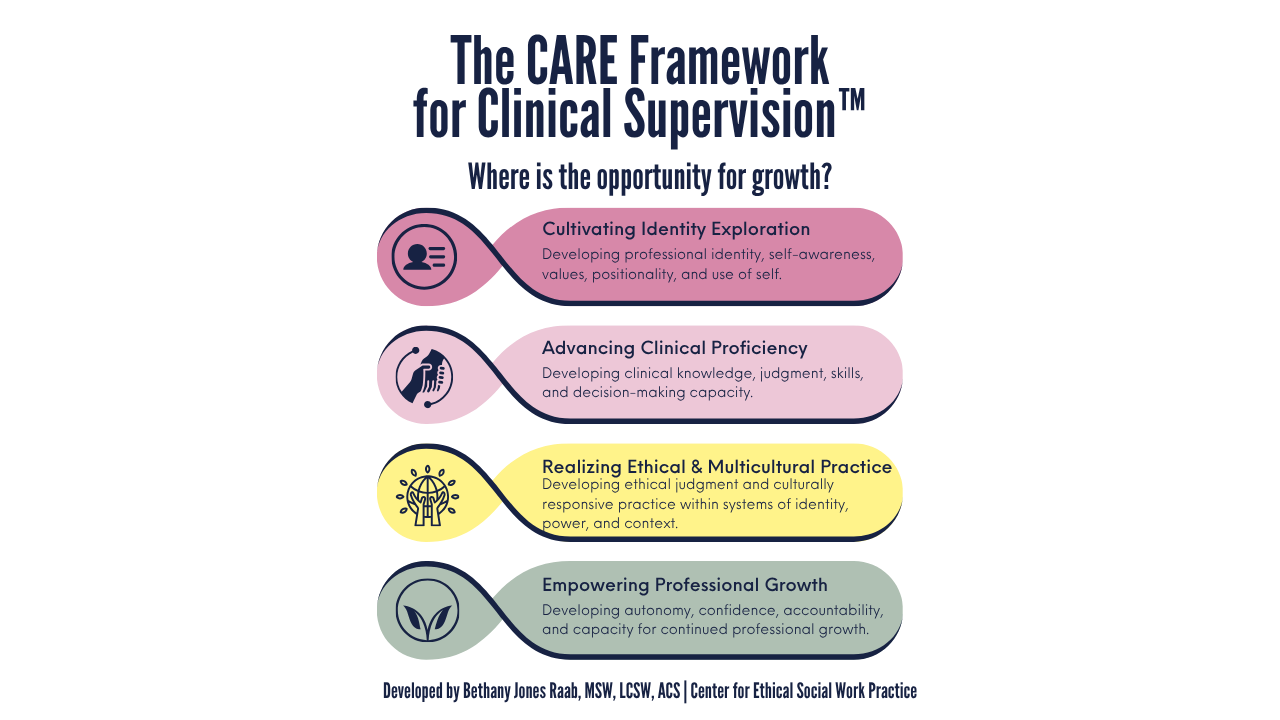
CARE offers four interconnected domains for understanding where growth may be needed:
Cultivating Identity Exploration
Advancing Clinical Proficiency
Realizing Ethical & Multicultural Practice
Empowering Professional Growth.
Looking Beyond the Immediate Question
The same supervisory concern can point toward very different developmental needs.
A supervisee struggling with a client who repeatedly misses sessions, for example, may need support strengthening clinical conceptualization and intervention skills. They may need to consider cultural context, access, power, or organizational policy. They may be struggling with what setting a boundary means about who they are as a social worker. Or they may need greater confidence making and communicating an independent clinical decision.
CARE helps the supervisor look beneath the presenting question and ask:
Where is the opportunity for growth?
The developmental opportunity may sit primarily within one CARE domain, span several, or shift as supervision progresses.
Cultivating Identity Exploration
Clinical development involves more than acquiring skills. Social workers are continually developing an understanding of who they are within the profession and how they bring themselves into their work.
This domain invites attention to professional identity, personal and professional values, positionality, use of self, assumptions, strengths, and the experiences that shape how a clinician understands their role.
Supervision within this domain might explore questions such as:
Who am I becoming as a social worker? What am I bringing into this interaction? How do my identities, experiences, values, and beliefs influence the way I understand this work?
Advancing Clinical Proficiency
Clinical proficiency includes the knowledge, judgment, skills, and decision-making capacity necessary for effective practice.
This may include assessment, case conceptualization, intervention selection, treatment planning, documentation, clinical boundaries, risk assessment, use of theory and evidence, and the ability to explain the reasoning behind clinical decisions.
The goal is not simply to tell supervisees what to do. Supervision helps clinicians increasingly understand how to think through clinical decisions themselves.
Realizing Ethical & Multicultural Practice
Ethical practice does not happen separately from culture, identity, power, or systems.
This domain asks supervisors and supervisees to consider ethical responsibilities alongside the cultural and systemic contexts in which practice occurs. It includes ethical decision-making, professional accountability, power and privilege, cultural responsiveness, competing responsibilities, and the ways organizational and social systems shape clinical choices.
Rather than treating ethics or multicultural practice as isolated topics, CARE recognizes them as ongoing dimensions of clinical judgment and professional responsibility.
Empowering Professional Growth
Supervision should help clinicians become increasingly capable of directing their own professional development.
This domain focuses on growing autonomy, confidence, accountability, professional judgment, leadership capacity, career development, and the ability to recognize and pursue future learning needs.
As clinicians develop, supervision can shift from providing answers toward helping supervisees trust, articulate, evaluate, and take responsibility for their own professional decisions.
CARE Is a Lens, Not a Checklist
The four CARE domains are not four boxes that need to be checked during every supervision session.
A single conversation may primarily involve one domain. Another may reveal connections among several. Over time, supervisors may notice that a supervisee consistently needs development within a particular area or that growth in one domain is influencing another.
CARE provides a way to notice these patterns and make more intentional decisions about where to focus supervision.
It can be used to structure supervision conversations, identify developmental goals, consider areas of strength and growth, inform feedback and evaluation, and reflect on whether supervision is addressing more than immediate case-management needs.
CARE and Developmental Supervision
CARE can be used alongside developmental models of clinical supervision rather than replacing them.
Developmental models help supervisors consider:
What does this supervisee need from me at this stage of development?
CARE asks:
Where is the opportunity for growth?
Supervisory judgment connects the two:
What do I do next?
A supervisor might identify clinical judgment as the developmental opportunity through CARE, for example, while recognizing that an early-career clinician needs more structure, instruction, and direct guidance than an experienced clinician working on the same capacity.
Together, these perspectives allow supervision to remain responsive to both what the clinician is developing and what they need from the supervisor to develop it.
Developing Clinicians, Not Just Solving Cases
Clinical supervisors regularly face immediate demands. Cases need attention. Ethical questions need answers. Documentation has to be completed. Risk has to be assessed. Decisions sometimes have to be made quickly.
CARE does not ask supervisors to stop addressing those realities.
It provides a way to use those moments for something more.
By asking where the developmental opportunity lies, supervisors can address the concern in front of them while also helping clinicians build the capacity to navigate future complexity with greater skill, ethical clarity, self-awareness, and professional autonomy.
The goal is not simply to help a supervisee handle this case. It is to help develop the clinician who will handle the next one.
Learn to Apply the CARE Framework
The CARE Framework for Clinical Supervision™ is integrated throughout CESWP's Clinical Supervision Training Program, where supervisors learn to use CARE alongside developmental theory, reflective supervision, ethical decision-making, evaluation, feedback, and supervisory leadership.
The CARE Framework for Clinical Supervision™ was developed by Bethany Jones Raab, MSW, LCSW, ACS, and is proprietary to the Center for Ethical Social Work Practice.
